How Barcode Labels Improve Daily Workflow?
July 3, 2026
If you’ve ever spent twenty minutes looking for a file, a product, or a package that should have taken twenty seconds to find, you already understand the problem that barcode labels solve.
Workflow inefficiency rarely announces itself dramatically. It shows up in small, repeated friction points. A misplaced item. A manual entry error. A stock count that doesn’t match. Multiply those moments across a team and a full working day, and the cost, in time, money, and frustration, adds up faster than most businesses realize.
Well-implemented barcode labels for business systems quietly eliminate most of that friction. And once it’s in place, it’s hard to imagine going back.
What Barcode Labels Actually Do for a Business?
At the most basic level, a barcode is a way of encoding information, a product ID, a price, a location, a batch number, in a format that a scanner can read instantly. No typing, no searching, no relying on someone’s memory.
But the real value of a barcode labeling system isn’t just the scan. It’s what the scan connects to inventory records, order management systems, and tracking databases. The label is the link between the physical item and the digital record, and that link is what makes real-time visibility possible.
When that system works well, the whole operation runs differently. Stock levels are accurate. Orders move faster. Errors drop. Accountability improves. And the time your team was spending on manual checks gets redirected toward work that actually needs human attention.
Where Businesses Feel the Difference Most
The impact of barcode labels for business setup shows up across different parts of a business, but some areas feel it more immediately than others.
Inventory management is the obvious one. Manual stock counts are slow, error-prone, and often outdated the moment they’re done. Barcoded inventory means stock can be tracked in real time, received, moved, sold, or returned, with a scan rather than a note. The numbers stay accurate without anyone having to reconcile them at the end of the week.
Order fulfillment speeds up significantly. Picking, packing, and dispatching are all faster when every item is clearly labeled and scannable. Mistakes, wrong items, and wrong quantities are dropped because the system catches them before they leave the building.
Asset tracking becomes manageable. Equipment, tools, devices, furniture, and anything of value that moves around an office or facility can be tagged and tracked. Lost or misplaced assets are easier to locate, and accountability is built into the process rather than assumed.
Documentation and compliance get cleaner. Industries with regulatory requirements, food, pharma, and manufacturing, rely on accurate labeling for traceability. A proper barcode labeling system creates a clear record that holds up when it needs to.
The Everyday Workflow Impact
It’s worth being specific about what changes day to day when barcode labels are properly implemented.
Your team spends less time doing things manually. Scanning is faster than typing, significantly faster, and with far fewer errors. A staff member who used to spend an hour reconciling stock manually can do the same job in minutes.
Communication across departments improves. When inventory and order data are updated in real time, purchasing, sales, and warehouse teams are working from the same information. Decisions get made on accurate data rather than outdated spreadsheets.
Customer experience gets better. Faster, more accurate order processing means fewer delays, fewer mistakes, and fewer conversations apologizing for both.
And perhaps most practically, onboarding new staff becomes easier. Barcode labels for business system reduce dependence on institutional knowledge. A new team member with a scanner and a clear process can operate effectively much sooner than one trying to learn a manual system built on habit and memory.
Getting the Labels Right
The system is only as good as the labels running through it. A few things that matter more than people initially realize:
Print quality. Barcodes that are smudged, faded, or poorly printed won’t scan consistently. That creates exactly the kind of friction the system is supposed to eliminate. Quality labels from a reliable supplier make a real difference here.
Durability. Labels in a warehouse, on outdoor equipment, or in a cold storage environment face conditions that standard paper labels can’t handle. The right material, whether that’s synthetic, laminated, or adhesive-specific, needs to match the environment.
Size and readability. A label that’s too small for the scanner distance, or printed at too low a resolution, creates scanning problems. Getting the specification right up front saves a lot of troubleshooting later.
Consistency. A barcode labeling system works because every item follows the same format. Inconsistent labeling, different sizes, different placements, and different encoding standards undermine the whole thing.
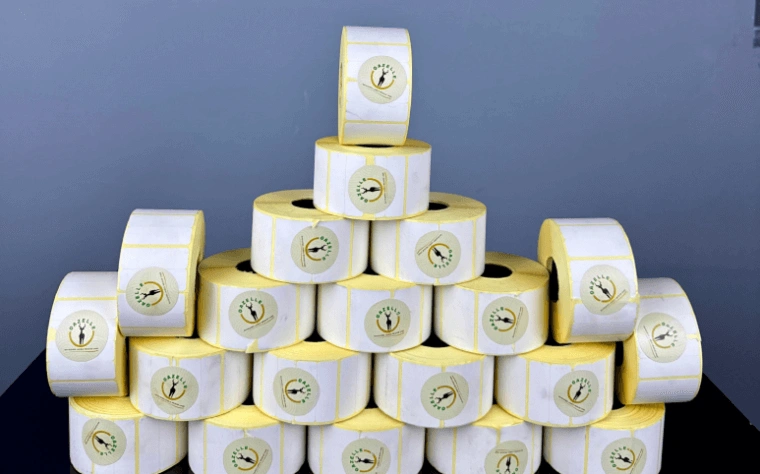
Crescent Stationery via Gazelle Label offers barcode label solutions built for business use, quality that holds up in real working conditions, and consistency that keeps the system running the way it’s supposed to.
The Bottom Line
A barcode labeling system isn’t a technology upgrade for its own sake. It’s a practical solution to a real operational problem, the daily friction of tracking, managing, and accounting for physical items in a business that’s trying to move efficiently.
The businesses that implement it well don’t usually talk about it much. They just run smoother, make fewer mistakes, and spend their time on things that actually move the business forward.
That’s the point.
FAQs
1.Do I need special software to use a barcode labeling system?
You’ll need software that can generate barcodes for printing and a system, inventory, POS, or asset management system that can read and store the scanned data.
2.How do I know which type of barcode label is right for my business?
It depends on your environment and what you’re labeling. Paper labels work fine for indoor, short-term use. If your items are exposed to moisture, heat, outdoor conditions, or heavy handling, you’ll need a more durable material.